
2026
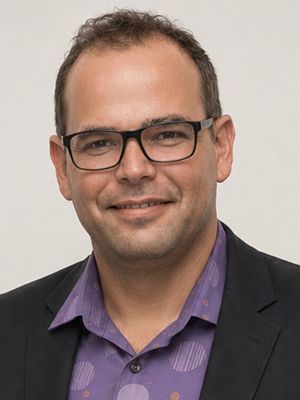
Prof. Re-an Müller
Pause. Play. Connect. Internal branding as an infinite game...read more
Prof. Re-an Müller
Pause. Play. Connect. Internal branding as an infinite game
Professor Re-an Müller opened his inaugural lecture by taking the audience to a flower bed with no flowers on a Free State farm, where as a boy he had played and built a make-believe farm. No flowers grew there, but creativity did. That image carried the evening.
Play like this, he explained, is an infinite game: there are no set rules, and the only aim is to keep on playing. Business is also an infinite game, one that requires an infinite mindset for long-term survival. Internal branding can be approached in the same way, through a specific focus on employees and on the connection between managers and their teams.
After his appointment as deputy director of the School of Management Sciences in 2022, he noticed that they had hit a wall during his first performance reviews. Colleagues offered only the “interview version” of themselves. So he purposefully paused with staff and used play as a gateway to connection, playing various games and weaving in strategic purposeful prompts. Once staff relax, a leader sees the person behind the job: the sick parent behind the missed deadline, the quiet ambition behind the extra effort. That connection reveals what no formal meeting does: insight into strengths and interests, who is ready for more, and ideas people only share when they feel at ease.
Play is well studied in therapy, education and team building, but rarely as a practice led by managers with their own teams. Professor Müller is developing the PLAYS Protocol to fill that gap: a practical guide to building brands from the inside out, one playful, purposeful conversation at a time.

Prof. Crizelle Els
Work or play? The serious business of fun at work...read more
Prof. Crizelle Els
Work or play? The serious business of fun at work
This inaugural lecture, “Work or play? The serious business of fun at work”, challenges the traditional assumption that work and play are opposites. Against the backdrop of increasingly demanding and digitally mediated workplaces, the lecture explores the role of play, humour, laughter and other brief positive experiences in helping employees recover from the cognitive, emotional and physical demands of work. Drawing on research in organisational psychology and related perspectives on psychological detachment, effort recovery, positive emotions, motivation and social connection, it considers why seemingly small moments of play may have consequences that extend beyond momentary enjoyment. Central to the lecture is the newly conceptualised Restorative Play Framework, which proposes that brief, intentional playful micro-experiences during the working day can interrupt ongoing strain and activate multiple restorative processes simultaneously. Five interconnected pathways are proposed: cognitive restoration, emotional restoration, social restoration, physiological restoration and identity restoration. Collectively, these processes may create moments of micro-restoration that replenish resources, renew energy and enable employees to re-engage with their work. Repeated over time, such moments may contribute to well-being, resilience, learning, engagement and sustainable performance. Importantly, the framework recognises that play is not universally restorative; rather, context – including individual preferences, job characteristics, leadership, psychological safety, organisational culture and cultural background – shapes its effects. Ultimately, the lecture argues that play may not be the opposite of productive work, but one of the resources that makes sustained, healthy and excellent work possible.

Prof. Herman Viviers
Reinventing accounting education for the “future world of work”: A scholarly journey of innovation, experimentation and reflective practice...read more
Prof. Herman Viviers
Reinventing accounting education for the “future world of work”: A scholarly journey of innovation, experimentation and reflective practice
Accounting education is increasingly challenged to prepare graduates for a professional environment shaped by digital transformation, artificial intelligence, hybrid work, ethical complexity and changing expectations of professional competence. In my address, I provide a future-oriented view of accounting education by arguing that technical competence, while foundational, is no longer sufficient on its own. Accounting graduates must also develop professional judgement, ethical awareness, digital acumen, communication competence, adaptability and a commitment to lifelong learning. Drawing on a scholarly trajectory in accounting education and taxation pedagogy, I have explored how authentic, active and simulation-based learning environments can support the development of these broader capabilities. Pedagogical innovations such as gamified tax interventions, interdisciplinary game-based learning and extended tax simulations are positioned as examples of structured educational experiences that enable students to integrate technical knowledge with professional values, attitudes and acumens. These approaches demonstrate that professional capability is not developed through instruction alone, but through carefully designed opportunities to act, decide, communicate, justify and reflect. My address further conceptualises accountants as accountable storytellers who interpret evidence, communicate financial meaning and bear responsibility for the consequences of their professional judgements. In this context, the future of accounting education lies in embedding technical knowledge within authentic, ethical, digital and reflective learning experiences. As accounting education teachers, we must continuously reimagine accounting education through innovation, experimentation and reflective practice to cultivate graduates who are responsive, resilient and professionally accountable in an evolving world of work.
2025

Prof Ermie Steenkamp
People, places and publications: An academic journey...read more
Prof Ermie Steenkamp
People, places and publications: An academic journey
Global trade generates vast amounts of data that, while rich in potential insights, is often underutilised due to its complexity and volume. Prof. Steenkamp extends the field of international trade analysis by applying and advancing data-driven market-selection approaches to identify trade opportunities, with a particular focus on African and other developing-country exporters. These approaches systematically evaluate exporter-product-market combinations using indicators such as the size and growth of import demand, competitiveness and market-access conditions. Across multiple studies, her research reveals underutilised trade potential at bilateral, regional and global levels, supported by product- and sector-specific analyses. The integration of this approach with complementary tools, such as competitiveness analysis, prioritisation methods and macroeconomic modelling, demonstrates how improved trade efficiency can convert unrealised potential into tangible economic gains. Her work on regional trade integration further shows that, while other world regions increasingly leverage their regional trade potential, African economies continue to face structural constraints that limit value-added production and intra-regional trade. This research provides actionable insights for unlocking Africa’s considerable yet underutilised trade opportunities, highlighting the importance of stronger market intelligence, greater policy coherence, reduced trade costs and enhanced institutional capacity.

Prof Rikus de Villiers
The death of compliance-based teaching: a new dawn for accounting educators...read more
Prof Rikus de Villiers
The death of compliance-based teaching: a new dawn for accounting educators
When I began teaching accounting, I equated excellence with coverage and exam success, designing courses around checklists, marking grids and exam technique drills. This approach rewarded accuracy rather than insight and encouraged students to ask “Is it examinable?” instead of exercising judgment. It suited large classes facing accreditation and other pressures, but it muted diverse voices and left graduates less confident when dealing with ambiguity, trade-offs and communication. I still value rigour, not rigidity. As the profession evolves with technology, integrated thinking and sustainability reporting, graduates need to work alongside analytics, automation and AI, while humans test assumptions, evaluate evidence and justify decisions. The focus is shifting from content delivery to developing competence: decision-making, digital fluency, relationship building and business acumen, as outlined in SAICA’s CA of the Future Competency Framework. Change is challenging. Legacy content, sunk costs, accreditation concerns and professional identity often hinder innovation. Yet AI is transforming routine tasks from execution to evaluation. We should redesign curricula and assessments to emphasise problem framing, evidence gathering, controls, scepticism towards AI outputs and narrative communication through multiple iterations that connect innovations to core outcomes. Embracing discomfort signals purposeful teaching. By addressing biases, pruning content and aligning time and assessments with human skills, we can develop accountants capable of challenging, controlling and communicating effectively, gaining trust and future-proofing the profession.