

SCROLL DOWN
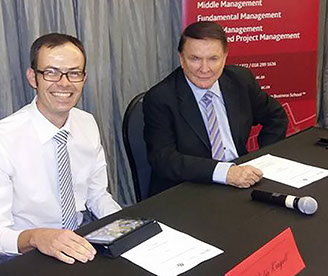
The Policy Uncertainty Index (PUI) is a joint project by the NWU School of Business and Governance and the School for Economics on the Potchefstroom Campus. It is under the leadership of Prof Raymond Parsons (right) of the School of Business and Governance. With him is Prof Waldo Krugell of the School of Economics.
The North-West University School of Business and Governance and the School of Economics on the Potchefstroom Campus have created a useful tool to measure the effects of decision-makers’ policies in South Africa.
Since the Policy Uncertainty Index (PUI) was successfully launched at a media conference in Johannesburg in February this year, two quarterly index reports have already been published. The next PUI will be released in mid-July 2016.
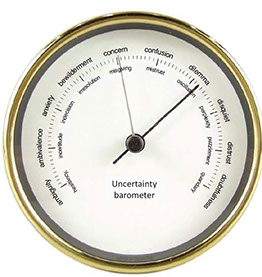
The aim of the PUI is to give South African decision-makers guidance to better understand and manage the effects of policy uncertainty on the economy, according to the NWU School of Business and Governance. A healthy, prospering economy benefits everyone in the country and the PUI will give decision-makers insight into the impact their policies have on the welfare of South Africa.
The PUI is the first of its kind for South Africa says Prof Raymond Parsons of the School of Business and Governance and leader of the PUI team. It is in line with a global trend that has already taken off in the United States, United Kingdom, Germany, France, India and China.
The birth of the PUI
“The big factor in the economic debate is policy uncertainty. Hardly any economic assessment in recent years from international or local financial institutions, economic analysts, financial journalists and credit rating agencies mentions the South African economy without referring to policy uncertainty,” says Raymond.
“So, I asked myself the question whether it was possible to capture this in a credible index that is adapted for South African circumstances.”
He says he started doing research and found almost a dozen indexes internationally. “We knew it would be possible and set up a task team together with the School of Economics to craft an index specifically for South Africa.”
Raymond says reducing policy uncertainty is imperative if we want to turn the South African economy around and put it on a higher growth path, and this is where the PUI will make an essential contribution in helping to measure policy uncertainty.
Three components to the index
The South African PUI has three underlying components: news coverage of uncertainty, the views of a group of leading economists on levels of policy uncertainty, and input from the Bureau for Economic Research from the University of Stellenbosch on policy constraints to doing business among manufacturers. A preliminary threshold of 50 was set. Any increase above 50 reflects greater policy uncertainty while a decrease below 49 reflects less policy uncertainty.
How does it work?
Press clippings are sourced from the top 20 publications in South Africa to quantify media reporting on policy uncertainty. These clippings are sourced using a list of keywords that are specified along with the term “policy”. These keywords include, among others, inflation, Rand, taxes, strike action, protest action and Constitutional amendment.
A survey was conducted among a group of private sector economists in South Africa to assess “uncertainty” among them. They were asked whether they think the level of policy uncertainty and uncertainty for foreign investors, domestic investors and consumers has increased, decreased or stayed the same.
Twenty-five economists have so far participated anonymously and Raymond says they intend to enlarge the group in future.
The School of Business and Governance also used data collected by the Bureau for Economic Research for their business confidence index on the political climate as a constraint on doing business.
An aggregate PUI is calculated from the average of these various inputs.
The value of PUI
The real value of the PUI lies in its ability to reflect people’s collective sentiment about the policy environment over a period of time. This will inevitably be influenced by a mixture of local and international decisions and events.
South Africa has enormous economic growth and development challenges and nothing less than a responsive and coherent policy framework will do. The PUI is well placed to reinforce this urgent imperative.
PUI is a vital addition to the economic landscape
Prof Dan Kgwadi, vice-chancellor, says the NWU has prided itself on promoting applied research in various key spheres and the development of the PUI represents a vital addition to the tools available for understanding the socio-economic and business environment.
“It fills an important gap in the range of statistical indices upon which decision-makers in both the public and private sectors must base their assessment of economic trends in this country. I congratulate the School of Business and Government team on the pioneering work done to mobilise the necessary international and domestic research in order to produce a highly relevant new economic index for South Africa.”
Prof Susan Visser, the Potchefstroom Campus’s acting vice-rector for research and planning, echoes this sentiment. “The PUI is an important piece of research which bridges economic theory with the needs of the business world in ways that can promote our understanding of a constantly changing economic universe.”
She says she is looking forward to seeing how trends in the PUI unfold over time and what the messages will be for decision-makers in the public and private sectors alike.
Click here to read the latest PUI for the first quarter of 2016.

CLICK HERE TO SCROLL DOWN
CLICK HERE TO GO TO THE TOP


