

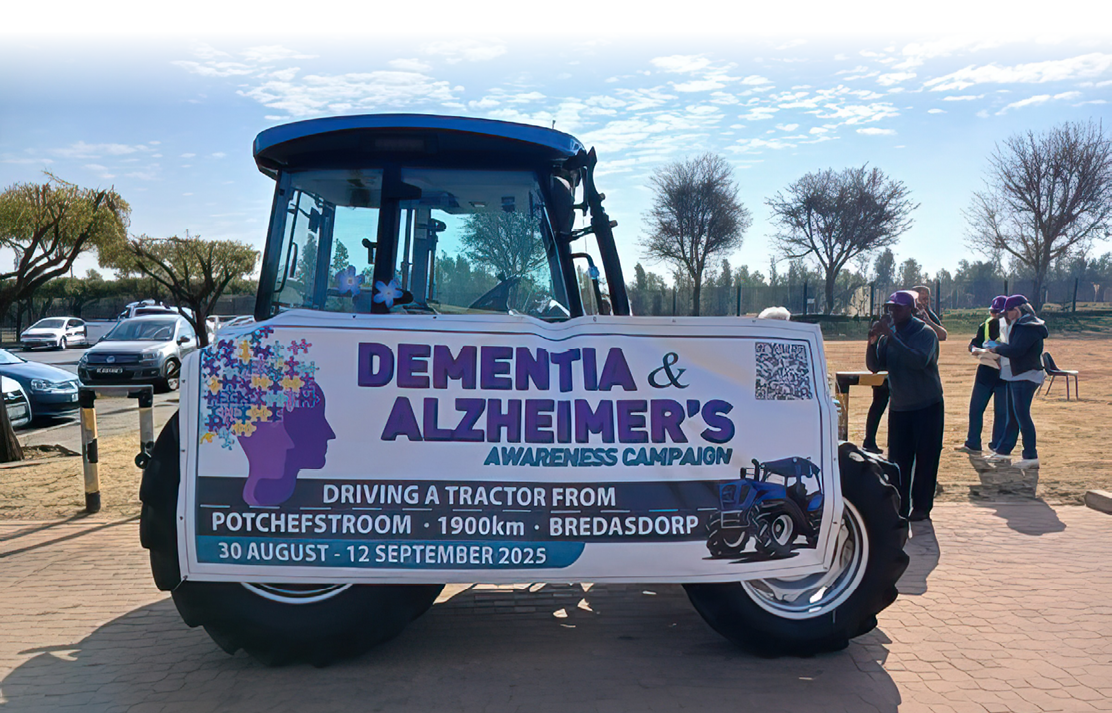
TRACTOR journey, a symbol of hope, remembrance, and community resilience across South Africa

IMPACT@NWU September 2025


The TRACTOR Campaign journey began on a bright and sunny Saturday morning, 30 August 2025, from the grounds of the Samuel Broadbent House in Potchefstroom. This was a deeply mean-ingful and symbolic start, as Samuel Broadbent House is renowned for its compassionate care for people living with Alzheimer’s and dementia, em-bodying the values of dignity and remembrance that the campaign sought to amplify.
The campaign team set off in a specially spon-sored Landini tractor. The tractor, an enduring and familiar symbol in many South African communities represents both the gradual, relentless progres-sion of dementia and the resilience and strength of those living with and affected by the condition. This 1900-kilometer tractor rally was not just a physi-cal trek but a moving narrative of hope, resilience, and solidarity, as the team made their way across South Africa, from Potchefstroom to Bredasdorp.
The urgent need for campaigns such as TRACTOR is underscored by the fact that more than 187,000 South Africans over the age of 60 are currently affected by dementia, with numbers projected to rise to 250 000 by 2030 (Alzheimer’s South Afri-ca, 2024). Awareness, education, and community support have never been more critical, as demen-tia remains one of the most under-recognised and misunderstood health challenges in the country. Increasing nationwide awareness through mean-ingful engagement and education can break down stigma, enable early diagnosis, and foster com-passionate care networks that sustain those living with dementia and their families.
As they travelled through towns including Klerks-dorp, Vryburg, Carnarvon, Calvinia, and Vanrhyns-dorp, the team made purposeful stops at old age homes, community centres, and local venues. At each stop, they engaged with communities through workshops led by healthcare professionals who shared valuable information about dementia care. Storytelling sessions brought caregivers, patients, and families together, creating safe spaces for sharing experiences, breaking down the stigma of memory loss, and fostering empathy.
In smaller towns such as Calvinia and Vanrhyns-dorp, the impact was particularly profound. Care-givers and elders expressed heartfelt appreciation for being recognised and supported. Local students from the NWU also joined the efforts, contributing by documenting stories and conducting commu-
nity research, thereby linking academic learning with meaningful social impact. The involvement of students enriched the campaign and empowered communities to sustain dementia support beyond the rally’s end.
The campaign also successfully mobilised local businesses, healthcare providers, and community leaders to forge lasting partnerships for enhancing dementia awareness and resources. The shared commitment underscored how collective action could begin to overcome the silence and isolation often experienced by those living with dementia.
After days on the road, the team arrived in Bre-dasdorp, where the journey’s stories of challeng-es, hope, and human connection were celebrated. The TRACTOR Campaign showcased the power of community and compassion, reminding South Africans that while memory loss may slow the jour-ney, together people can continue moving forward, united in remembrance and care.
The profound impact of the TRACTOR Campaign was only made possible through the relentless ded-ication, passion, and compassion of the core team. Their unwavering commitment ran deeper than lo-gistics; they became beacons of hope and pillars of support for countless families and communities met along the route. Esmé Marks, steering as proj-ect manager and tractor driver, supported by her two sisters Debbe Pieterse and Rene Daffue navi-gated challenging terrains with resilience.
Prof. Carlien van Wyk and Prof. Sanette Brits pro-vided steady leadership and led with heart and de-termination with supporting materials and scientific know-how, with three members from the Faculty of Health Sciences joining them on the road. Tsh-wanelo Maleko and Thendo Nemavhandu ensured that these invaluable stories reached far beyond the rally stops, fostering a national conversation. The medical support provided to the tractor driv-ers by Werno Foit was attentive and compassion-ate, while the steadfast, behind-the-scenes efforts of the team not listed here covering road safety, tractor maintenance, financial management, and the daily well-being of the rally group ensured the smooth running of the campaign.
Together, their presence elevated the initiative from a campaign into a movement, one that brought dig-nity, visibility, and hope to a cause too often over-looked.
Acknowledging the TRACTOR team and their contributions
In honour of those who carried this vision forward, the campaign gratefully acknowledges the following individuals whose roles were pivotal to the journey’s success:
Esmé Marks – Team Leader / Tractor Driver
Debbe Pieterse – Tractor Driver
Rene Daffue – Tractor Driver
Prof. Sanette Brits – Faculty of Health Sciences Support
Prof. Carlien van Wyk – Faculty of Health Sciences Support
Thabisile Mpofana – Faculty of Health Sciences Support
Nonkululeko Navise – Faculty of Health Sciences Support
Tshwanelo Maleko – Media and Communications
Thendo Lucky Nemavhandu – Media and Communications
Sandra Lin – Financial Management
Gert Benade – Mechanic
Werno Foit – Medic
Solly Grace – Service Provider
Donald Mugodhi – Roll-bed Driver
While we highlight the dedication of this core team, we also recognise the invaluable contributions of many other stakeholders, partners, and sponsors whose support sustained this journey. Their formal acknowledgement will take place during the upcoming “Homecoming Event” in October, where all will be celebrated for their part in making the TRACTOR Campaign a true movement of hope, remembrance, and resilience.